Oct 20 2014
Reflection on cataract screening trip – Kevin Lam
Reflection on cataract screening trip (by Kevin Lam)
From the 14th to 18th of September, I left for Yang Shan (陽山縣), Qingyuan (清遠市) to help screen patients from a total of 6 towns, namely 七拱鎮, 太平鎮, 黎埠鎮, 青蓮鎮, 岭背鎮 and 陽城鎮, for cataract surgery. The screening process was performed in cooperation with a local medical team.
The workflow of each day was similar. Registered patients were first subject to visual acuity test, followed by assessment by the local doctor using a slit lamp, and finally pre-surgical checkups if they were considered priority cases for surgery. My responsibilities in the morning sessions included helping with simple and basic checkups such as measuring blood glucose and taking blood pressure for potential patients in imminent need of cataract surgery. In the afternoon sessions, I helped maintain the queue and directed patients to specific check-up stations in the clinic.
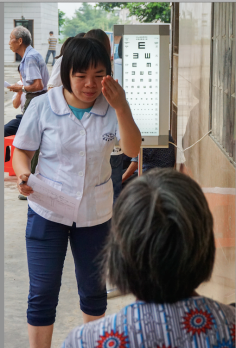
One of the local medical team members was performing visual acuity test for the registered patients
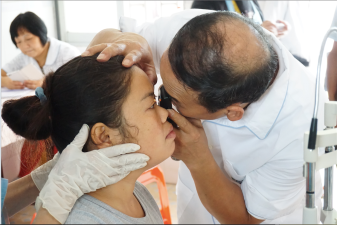
The local medical doctor was carefully and closely examining her eyes.
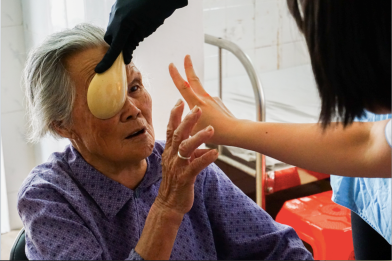
This old woman failed to recognize the largest words displayed on the visual acuity test light box, so the medical team members decided to check her ability to see objects within a shorter range by asking her how many fingers she could see.
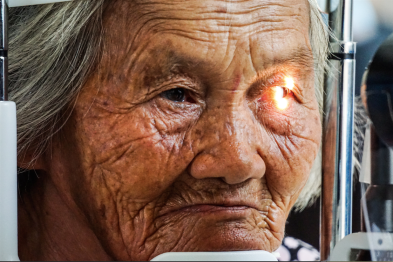
The local medical doctor was assessing the severity of her cataract as well as looking for other potential eye disorders.
Sometimes, when the occasion became less busy, the local medical doctor would explain to us the common eye disorders affecting the population. I was introduced to mainly two disorders, cataract and pterygium. Cataract is characterized by the formation of cloudy substances in the lens, which blurs vision, while pterygium is the non-malignant ocular growth of the conjunctiva, covering the sclera and extending to the cornea, and thus impairing vision. One of the causes of pterygium is thought to be persistent exposure to UV light. Therefore cases of pterygium in Yangshan is more prevalent than in Hong Kong, as the rural people mainly subsist on agriculture and had to work under the sun for a relatively prolonged period of time with very limited or no necessary protection. The doctor also briefly taught us how to use a slit lamp to identify and distinguish between cataract and pterygium.
From the pre-surgical checkups for which I was responsible, I surprisingly found that the people in Yangshan are generally healthier than those in Hong Kong, as reflected by the majority having normal blood glucose and blood pressure readings. This maybe explained by the fact that they usually live on simpler, healthier and non-processed foods as opposed to food rich in salt, oil and sugar enjoyed by Hong Kong people.
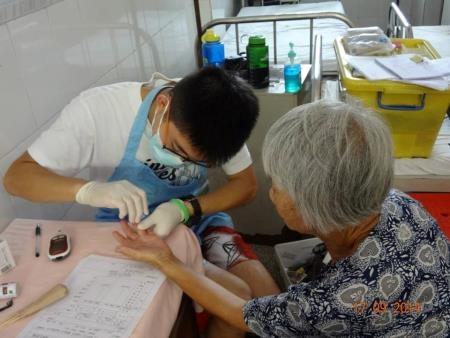
I was helping with the checking of blood glucose level, as part of the pre-surgical check-up procedures.
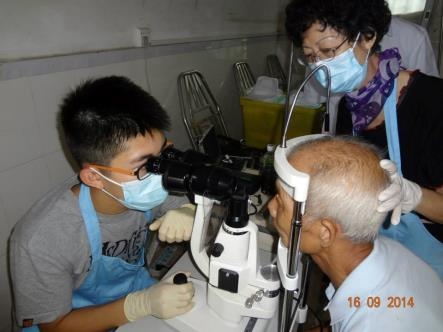
Sometimes, when there were not so many patients and the local medical doctor was free, he would give us a chance to see how a cataract lens looks like using a slit lamp.
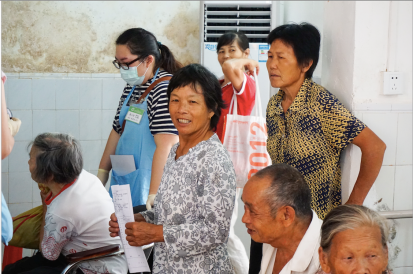
The registered patients were happily waiting for the cataract check-up.
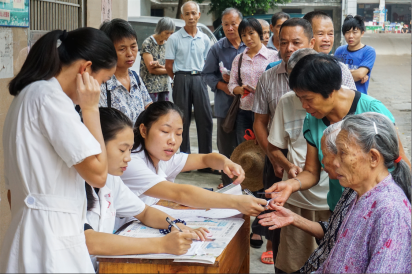
There were so many people at the clinic. Luckily, we had the local staffs (nurses) to help with the registration process.
Most registered patients we encountered, expectedly, were elderlies ranging from age 65 up to 90 and some of whom are single-living elderlies. I feel especially sympathetic to those who are unable to see objects at a distance of 40cm or beyond. Traditional proverb says “the eyes are the window of the soul”. Vision indeed occupies the highest place in the body. Imagine not being able to walk, eat and live on your own, and most importantly, not being able to enjoy and appreciate the intrinsic beauty of the world. It is, to us, presumably unbearable. Luckily, this misfortune of theirs can be altered by Green Action, allowing them to rejuvenate vision, regain the window of the soul, restore their innate sense and live an entirely new life.
Quite unfortunately, yet inevitably, patients necessitating imminent cataract surgery outnumbered our pre-set quotas (151), whereby they may have to wait until the next surgery session despite having quite serious cataract. All I can do is to hope they could live a healthy lifestyle for the time being and receive the necessary treatment at the earliest time possible.
Perhaps the most worrying was the elderlies suffering from severe cataract, yet at the same time suffering from other chronic diseases such as high blood glucose/diabetes and blood pressure. Not until they have their chronic diseases treated they can undergo the surgery. I would really hope they could free themselves from these diseases and afterwards receive surgical treatment before the severity of their cataract becomes irreversible.
The most valuable of this trip is not the opportunity to practice taking blood pressure and glucose, but the opportunity to realize how afflicted the lifestyle of the local rural population is, how cataract or other eye disorders have been impacting on their lives and how we, as volunteers, together with the local medical team, can provide assistance to these individuals in need. In addition, I gained an understanding of the healthcare setting and quality in such less developed regions and compared it to Hong Kong’s. We came across a little boy who once suffered from congenital cataract and his parents paid to a local hospital for cataract surgery on their son. However, his cataract recurred few years after the surgery. The doctor in our medical team, after performing a series of preliminary inspection, suspected a potential mistake or partial failure of the previous surgery, hence requiring follow-up procedures. The doctor pointed out that even though he undergoes the surgery again, the effect might not be as ideal as it would had been for the first time. This may reflect the fact that the healthcare quality leaves much room for improvement. I feel extremely woeful not only for his rather unfortunate gift – congenital cataract – but also how his little chance of gaining back his complete vision had been devastated by such an inadvertent medical mistake. Nevertheless, what draws my great appreciation are the parents’ positive attitudes, caring and support towards their son. They still maintained an optimistic view of their son, in spite of his current plight, and believed he would regain his vision soon.
All in all, it is my pleasure and I feel fortunate to participate in this trip. It has offered me insight into the living conditions and lifestyles of the local rural population, healthcare quality, and how these are compared to Hong Kong's. And I feel self-satisfied to assist the local medical team in screening patients for surgery, so that they could restore their vision and see the world differently. As a university student, knowledge acquisition from lectures, tutorials and textbooks is indeed important, but I would regard the experience from this kind of service trip as something that we should not neglect. Exposure to other places outside our homeland alters the perspective from which we view things in the world. Therefore I will surely engage in similar service trips when opportunities knock at my door.
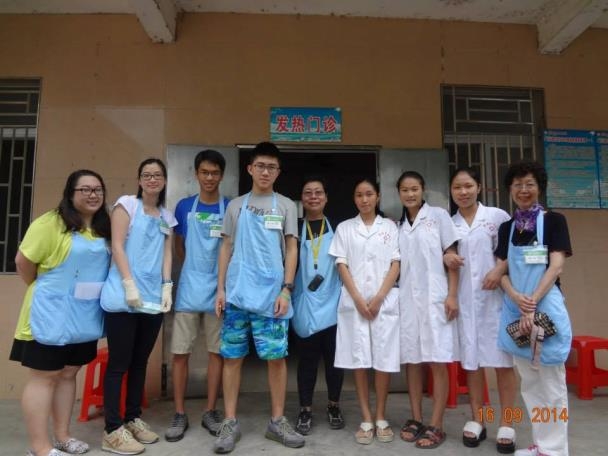
This group photo was taken after we finished our cataract check-up sessions in the morning at黎埠鎮. The ladies in white coat on the right are the local nurses who assisted us in the registration process as well as translation. Without their help, our workflow would not have been that smooth.
Kevin Lam (林家穎) - CUHK Year 2
11th October ,2014
Comments Off


